The Enterprise. Simplified.
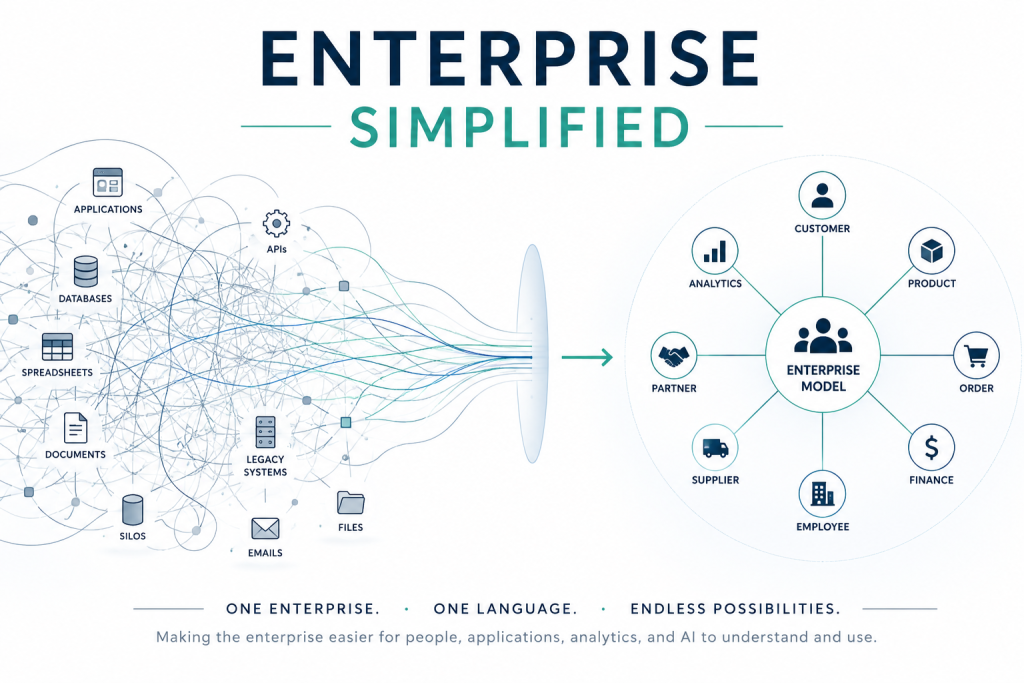
Enterprise Simplified explores a simple question: as AI becomes more capable, does the enterprise need to become more technologically complex to support it, or do we need to make the enterprise itself easier for people, applications, analytics, and AI to understand and use?
This article is Part 1 of the Enterprise Simplified series and was originally published on Medium.
Making Enterprise Complexity Manageable
From conference to conference. From customer to customer. From AI initiative to AI initiative. There is one theme that consistently emerges.
The enterprise is complicated.
Every year we introduce new applications, cloud platforms, data products, integrations, AI capabilities, and ways of working. Each solves an important problem. Each delivers value. Yet each also adds another layer to an already complex enterprise.
Everyone wants to innovate. Today, much of that excitement surrounds AI because, for the first time, interacting with sophisticated technology feels natural. We can simply talk to it. It is easy to imagine AI answering questions, automating work, and helping us make better decisions.
But communicating effectively has always required more than language, whether we are communicating with a person or a machine.
Good communication depends on shared understanding. Even between people, words alone are rarely enough. We naturally adapt what we say based on who we are speaking to, what they already know, and the context surrounding the conversation. We explain relationships, clarify meaning, establish assumptions, and fill in what is not already understood. Much of this happens so naturally that we barely notice it.
Machines face the same fundamental requirement, but without much of the shared experience and implicit understanding that people bring to a conversation.
Our enterprises rarely do the same.
Instead, we ask people — and now AI — to navigate thousands of applications, databases, APIs, reports, integrations, and datasets, each exposing only a small piece of how the business actually works. Every project develops its own interpretation of customers, products, suppliers, employees, and orders. Every implementation introduces its own terminology, business rules, security model, and assumptions.
It shouldn’t surprise us that the enterprise becomes increasingly difficult to understand and increasingly expensive to change.
Over the past several decades, we’ve invested heavily in analytics, integration, cloud computing, master data, semantic technologies, and now AI. These investments have delivered tremendous value, but they have largely optimized individual solutions rather than the enterprise itself.
Perhaps we need to alter our perspective. Instead of asking how to make every new technology understand our increasingly complicated enterprise, perhaps we should ask a different question.
What if we made the enterprise itself easier to work with?
Not by simplifying the business.
Businesses are inherently complex.
But by creating a simplified representation of the business that every like people, applications, analytics, automation, and AI alike can understand.
That is the idea behind The Enterprise. Simplified.
This series is built on a simple premise: enterprise complexity is unavoidable, but exposing that complexity to every consumer is not. Just as software companies present stable capabilities while hiding implementation details, enterprises should present stable representations of the business while allowing the underlying technology to evolve independently.
Doing so changes more than how people interact with information. It changes the economics of the enterprise. A stable enterprise representation reduces repeated development, simplifies maintenance, centralizes security and governance, improves consistency, and enables every new initiative to build upon enterprise assets instead of recreating them.
The first article, this one, introduces that vision.
The articles that follow explore how to make it a reality.
In Part 2 — Separating Business from Implementation, I’ll examine why business concepts should remain independent of the applications and technologies that implement them.
In Part 3 — Enterprise Information as a Business Asset, I’ll explore how enterprise entities become reusable organizational assets rather than outputs of individual projects.
In Part 4 — Business Capabilities Operationalize the Enterprise, I’ll discuss how business capabilities expose those enterprise assets through stable actions, creating a consistent way for applications, analytics, automation, and AI to interact with the business.
Finally, in Part 5 — Why AI Needs Enterprise Representation, I’ll bring everything together and show why enterprise-scale AI depends more and more on providing AI with a stable, implementation-independent representation of the enterprise.
This is not a series specific to any technology, such as AI. It’s a series about building enterprises that are simpler to understand, easier to change, less expensive to operate, and better prepared for whatever technology comes next.

About The Author

Terry Dorsey
Terry Dorsey is an enterprise architect, AI and data strategist, researcher, educator, and industry thought leader with extensive experience turning emerging technologies into practical enterprise capabilities. Her career spans enterprise architecture, data and integration strategy, AI operationalization, business transformation, and technology leadership. As a practitioner, she has designed and led enterprise capabilities supporting global business operations and served as an AI technical strategist, bridging AI research with the data, processes, architecture, infrastructure, and organizational capabilities required for real-world adoption. Today, Terry works with business and technology leaders on enterprise data and AI strategy while continuing her research and graduate-level teaching. She is a frequent conference speaker and webinar presenter and has contributed through interviews, industry publications, research, and blogs. Her work increasingly focuses on a fundamental question: how can enterprises better represent and organize their information, meaning, relationships, behaviors, and context so that people, applications, analytics, and AI can use them more effectively?