The Enterprise. Simplified. (Part 5)
Why AI Needs Enterprise Representation
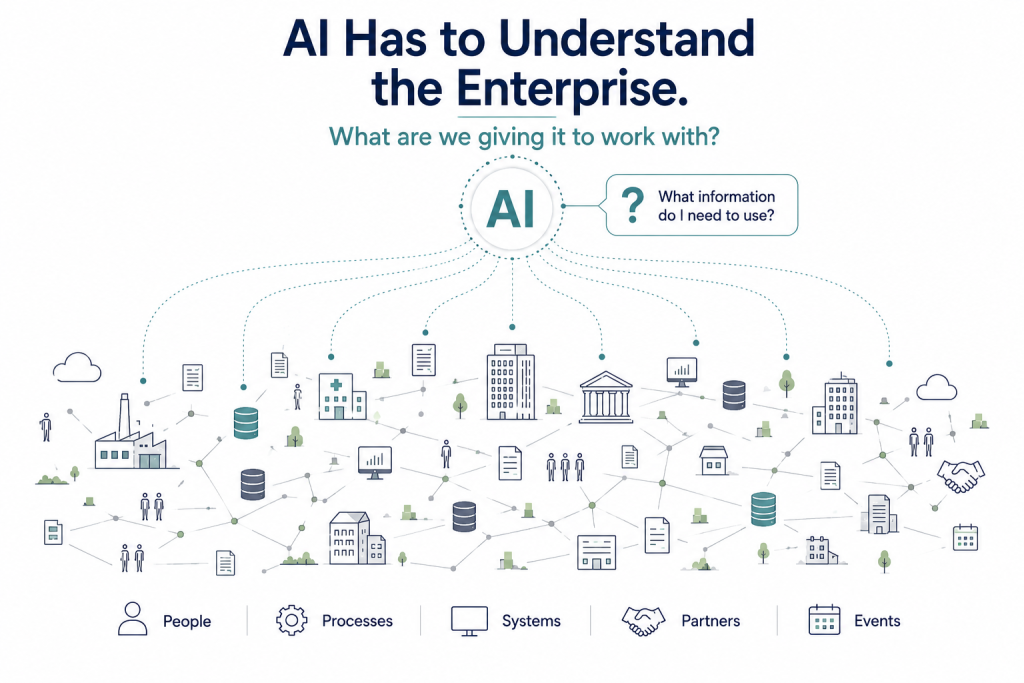
This is the final part, Part 5 of The Enterprise. Simplified. In Part 4, I covered how business capabilities operationalize the enterprise.
One of the questions that have been asked most often over the past year is surprisingly simple.
“Why does AI struggle so much inside large enterprises?”
The answers are usually technical. Models need better prompts. Retrieval needs improvement. Context windows need to become larger. Semantic layers need to be richer. Knowledge graphs need to be expanded. Governance needs to mature. Agent frameworks need additional capabilities.
I don’t disagree with any of those observations. They’re all important. Some may be symptoms, others may be problems in their own right, but they don’t exist independently. They are part of a larger architectural challenge: how the enterprise represents, governs, connects, secures, and makes its information and capabilities available to the people, applications, analytics, and AI that depend on them.
Throughout this series, I’ve argued that enterprise architecture has gradually become centered on implementations. Projects deliver applications. Applications create representations of the business. New projects begin by interpreting those representations and producing new ones. Data warehouses, lakehouses, semantic layers, APIs, and AI platforms all improve how information is consumed, but they typically begin with the same implementation-centric view of the enterprise.
AI Focuses the Issue
Perhaps AI simply exposes that problem more clearly than previous technologies. Think about how people work.
When a new employee joins an organization, they don’t begin by reading database schemas or studying API specifications. They learn what a customer is, how an order flows through the business, who is responsible for approving credit, how products are organized, and what information is important to each business function. In other words, they first develop a mental model of the enterprise before learning how individual applications support it.
We rarely give AI that same advantage.
Instead, we ask it to interpret thousands of tables, APIs, reports, documents, and application-specific representations, hoping it can reconstruct the business from its implementations. We continue adding retrieval systems, governance artifacts, and increasingly sophisticated reasoning capabilities to compensate for the fact that the enterprise itself has never presented a coherent representation of what it is.
That’s an extraordinarily difficult problem. Not because AI lacks intelligence. Because we’ve asked it to infer the enterprise rather than present the enterprise.
Throughout this series, I’ve suggested a different perspective.
The enterprise should present a stable, business-oriented representation of itself: its core information, the relationships among it, the behaviors that govern it, and the capabilities through which work gets done. That representation should be actionable, not simply descriptive. Through the same business abstractions, people, applications, analytics, and AI should be able to observe enterprise state and invoke the actions that create, modify, approve, fulfill, or otherwise affect it. Together, these elements create the enterprise representation I’ve been describing throughout this series.

If that foundation exists, something interesting happens.
An AI agent asked to create an order doesn’t begin by discovering which ERP system manages orders or which APIs belong to which application. It begins with the enterprise action Create Order. The action defines what is required to perform the work based on established business policy and procedure, and can apply the necessary logic, determine or route to the appropriate implementation, and coordinate the underlying execution. The systems, APIs, and logic involved may change without requiring the consumer to understand those changes or altering the business meaning of Create Order.
Once the order is created, the agent should not have to drop back into those systems to determine what happened. The resulting Order and its current state should be immediately observable through the same enterprise abstraction. The agent can see that the order now exists, its status, its relationships to the customer and products, and other relevant business state without needing to know where that information is physically maintained.
The abstraction therefore supports more than understanding the enterprise. It provides a consistent way to understand its state, act upon it, and observe the resulting state.
The same principle applies to understanding customers, evaluating suppliers, approving invoices, analyzing inventory, or reconciling financial information. AI no longer needs to reconstruct the business from thousands of implementation artifacts because the enterprise already presents its information, relationships, behaviors, and available actions through stable business abstractions.
Enterprise Architecture. Simplified.
Notice that this isn’t really an AI architecture. It’s enterprise architecture. People benefit from the same representation. Developers benefit from it. Integration platforms benefit from it. Analytics platforms benefit from it. Partners benefit from it.
AI simply becomes another participant interacting with the enterprise through the same abstractions. That’s why I don’t think the long-term challenge is only making AI increasingly capable of understanding enterprise implementations.
It is both.
AI will continue to become better at interpreting complex environments, determining what matters, and deciding how to act. At the same time, we have an opportunity to make the enterprise itself easier to understand and interact with by providing a clearer, more consistent representation of its information, relationships, behaviors, state, and available actions.
AI may also help us build and maintain that representation. Working with business and information architects and subject matter experts, AI could help discover relationships, identify inconsistencies, surface implicit rules and behaviors, and translate operational knowledge into governed enterprise abstractions. Human expertise would still establish meaning, authority, policy, and intent.
The longer-term opportunity, then, is not simply better AI or a simpler enterprise. It is both: increasingly capable AI interacting with an enterprise that is increasingly explicit about what it is, how it works, and what can be done.
We’ve spent decades improving how information is stored, integrated, governed, secured, analyzed, and distributed. Those investments have created significant value. But as enterprises have grown more complex, our understanding of them has become increasingly tied not only to systems and data structures, but to the many projects and solutions that have created their own representations of enterprise information, relationships, behaviors, and capabilities over time.
The next step is ensuring that we can represent the enterprise more consistently across those implementations, making its business meaning, relationships, behaviors, and capabilities explicit while abstracting unnecessary implementation complexity.
This reinforces the importance of business and information architecture working closely with subject matter experts. Together, they establish the enterprise representation of its information and capabilities, including the relationships, behaviors, policies, and procedures that define how they work. The opportunity is to make those representations operational, not simply documented, so they provide stable business abstractions through which people, applications, analytics, and AI can understand the enterprise, observe its state, and execute permitted actions.
Those representations can also provide continuity as technology changes. New and replacement systems should align to established enterprise capabilities and representations instead of redefining them through their own implementation. And when the business establishes, changes, or extends a capability, the enterprise representation can evolve accordingly and provide direction for the technologies that implement it.
This does not necessarily require a new organizational structure, but it does create an important place to strengthen ownership, accountability, and governance around who establishes these representations, how they change, and how implementations align to them.
For many organizations, this will also require technology capable of operationalizing the representation across existing systems, data, and applications without requiring them to be replaced. It may also change how projects are approached: beginning with established enterprise capabilities and representations, aligning to and reusing them where appropriate, and extending them when the business requires something new.
If we can separate our understanding of the enterprise from the technologies and individual projects that implement it, we create a more adaptable foundation for AI and whatever comes next. The enterprise representation can evolve as the business itself evolves without being redefined every time the underlying technology changes.
The technologies will continue to change. The enterprise shouldn’t have to.

About The Author

Terry Dorsey
Terry Dorsey is an enterprise architect, AI and data strategist, researcher, educator, and industry thought leader with extensive experience turning emerging technologies into practical enterprise capabilities. Her career spans enterprise architecture, data and integration strategy, AI operationalization, business transformation, and technology leadership. As a practitioner, she has designed and led enterprise capabilities supporting global business operations and served as an AI technical strategist, bridging AI research with the data, processes, architecture, infrastructure, and organizational capabilities required for real-world adoption. Today, Terry works with business and technology leaders on enterprise data and AI strategy while continuing her research and graduate-level teaching. She is a frequent conference speaker and webinar presenter and has contributed through interviews, industry publications, research, and blogs. Her work increasingly focuses on a fundamental question: how can enterprises better represent and organize their information, meaning, relationships, behaviors, and context so that people, applications, analytics, and AI can use them more effectively?